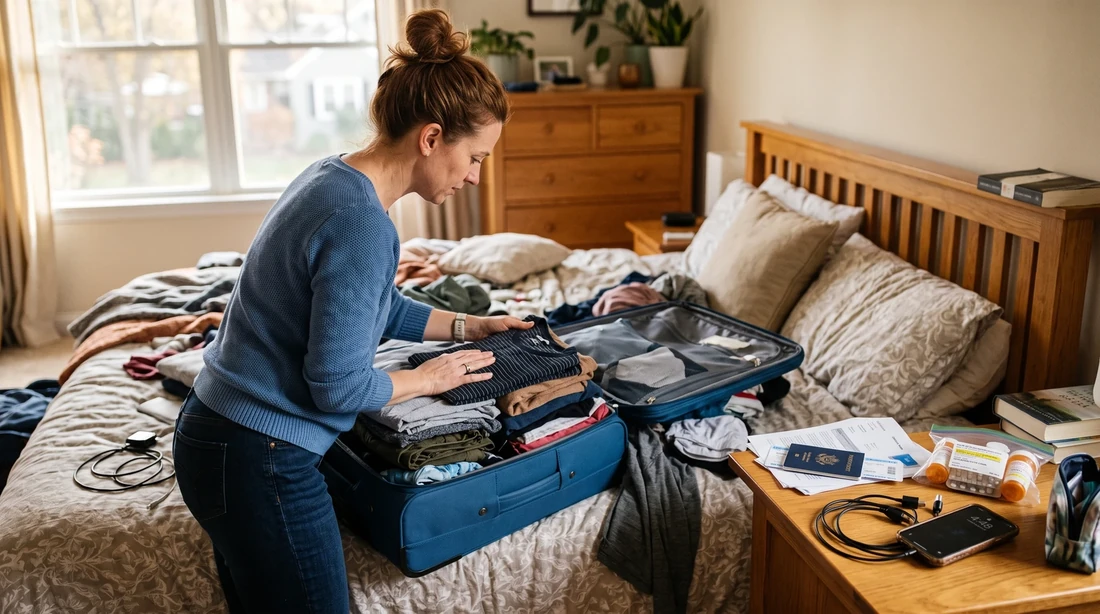
Bring documents, medications, a week of clothes per person, phone chargers, and anything irreplaceable — a fully furnished rental already supplies the beds, linens, full kitchen, cookware, towels, Wi-Fi, and laundry. A hotel supplies almost none of that, so a furnished home shrinks your packing list to a few suitcases instead of a moving truck.
Key Takeaways
- A furnished rental supplies beds, linens, kitchen, cookware, towels, Wi-Fi and laundry; you pack documents, medications, a week of clothes, chargers.
- Grab documents, prescriptions, glasses, chargers, photo backups and pet meds first, because remediation crews may seal off the damaged area entirely.
- Photograph damaged items in place before moving them, and do not launder smoke-exposed clothing before an adjuster or contents specialist reviews it.
- BnB OKC stocks 11 metro homes; published from-rates run $165 to $425/night, with up to 35% direct-booking savings on 4+ night stays.
This guide covers what a furnished rental already stocks so you can leave it behind, the short list of things only you can bring, how to sort everything by priority when you have minutes rather than hours, what changes for babies, medical needs, remote work, and OKC's seasons, and how the packing load and the cost compare across a hotel, an extended-stay, and a furnished home.
Your pipe burst overnight, the water hit the drywall and floors, and your adjuster says the repair will run six to eight weeks. Now you are standing in a soggy hallway trying to decide what to grab. The single most useful fact: a furnished rental already contains almost everything a household runs on, so what you need to pack is small, personal, and specific.
This is a room-by-room packing list built for exactly that moment, split into what a furnished home like ours already provides versus what only you can bring. It doubles as an honest look at how much less you haul when your temporary housing has a real kitchen instead of a mini-fridge.
Every day you camp in a hotel room without a stove, you spend on restaurant meals that a furnished kitchen would erase, and those meals may not all be reimbursable under your policy. The faster you land somewhere with real appliances, the less your out-of-pocket burn.

Why Is Your Packing List Shorter Than You Think?
A furnished rental replaces roughly 80% of a typical household's daily-use items, so displaced families over-pack out of panic more often than they under-pack. Headed to a hotel? You will need far more: no kitchen, no laundry, no cookware. Headed to a furnished home? You are packing for a long trip rather than a move.
The difference matters most for stays of 30 days or longer. A burst-pipe flood or a house fire rarely wraps up in a week. A six-to-eight-week timeline means you will cook, do laundry, and live like a household instead of surviving on takeout. Learn the full sequence in our guide to temporary housing after a house fire.
Before you pack anything, confirm your coverage. Most homeowner and renter policies include loss-of-use, which pays your additional living expenses while you are displaced. Read loss of use coverage explained and does renters insurance cover temporary housing to know your limit before you rack up costs.
On checking your policy before you count on coverage:
However, if something happens to the home, and the event is on the exclusions list, the policy will not provide coverage.
Wikipedia: Home insurance
What Does a Furnished Rental Already Provide?
A fully furnished home supplies every major system a hotel cannot: a real kitchen, in-unit laundry, full bedding, and living space. Below is what our BnB OKC homes come stocked with. Cross it off your list.
| Room | Furnished rental provides | You bring |
|---|---|---|
| Bedroom | Beds, mattresses, sheets, pillows, blankets, dresser, closet, hangers | Clothes (1 week+), pajamas, laundry bag, phone charger, any special pillow |
| Kitchen | Full-size fridge, stove, oven, microwave, cookware, dishes, utensils, coffee maker, toaster | Pantry staples you prefer, spices, kids' snacks, any specialty appliance |
| Bathroom | Towels, hand towels, hair dryer, starter toiletries | Prescriptions, personal toiletries, contacts/glasses, makeup, refills |
| Living room | Sofa, TV, Wi-Fi, seating, décor, lamps | Laptop, work gear, chargers, favorite books/toys, streaming logins |
| Laundry | Washer, dryer, iron, ironing board | Your preferred detergent (optional), delicates bag |
A hotel supplies only the towels and a mini-fridge from that entire list, which is why a hotel packing list balloons and a furnished-home list stays at a few suitcases.
What Should You Pack First, No Matter Where You Stay?
Some items are irreplaceable or urgent no matter where you stay. Pack these first, before clothes. This is the non-negotiable core.
Documents and financial
- ID, passports, birth certificates, Social Security cards
- Insurance policy number and adjuster's contact info
- A running photo log of damaged items (for your claim)
- Checkbook, cards, and one backup payment method
- Vehicle titles, lease, or mortgage paperwork if reachable
Health and safety
- All prescription medications and a list of doses
- Glasses, contacts, hearing aids, medical devices
- A small first-aid kit
- Pet medications, food, leash, and vaccination records
Daily function
- Phone, laptop, and every charger and cable
- Work badge, keys, and any tools you need remotely
- Kids' school supplies, comfort items, a favorite toy each
- One week of clothes per person, plus shoes and a jacket
Irreplaceable
- Photo albums, hard drives, external backups
- Small heirlooms and sentimental items you can carry
- Anything that can't be repurchased or reissued
Grab these in your first trip, because you may not get a second one. After a fire or a serious flood, the remediation crew often seals the damaged area, cuts power to it, or bars re-entry entirely while they dry and demo. Assume the room you are standing in could be off-limits by tomorrow morning, and pull anything irreplaceable now rather than planning to "come back for it."
Pack by priority: grab-first, nice-to-have, leave behind
When you have minutes, sort every item into one of three bins. The biggest bin is usually "leave behind," because the rental already stocks it. This triage keeps you from packing a moving truck of things a furnished home already owns.
| Priority | Items | Why |
|---|---|---|
| Grab first (irreplaceable/urgent) | Documents, meds, glasses, chargers, photo backups, cards, pet meds | Slow or impossible to replace; needed for the claim and daily life |
| Pack if there's room | A week+ of clothes, work gear, kids' comfort items, preferred toiletries | Replaceable but expensive or inconvenient to rebuy |
| Leave behind (rental provides) | Bedding, towels, cookware, dishes, small appliances, furniture, TV | A furnished home already supplies all of it; a hotel supplies almost none |
If you are bound for a hotel, half the "leave behind" column jumps back onto your list, because the room will not have it. That is the packing tax of a mini-fridge and no stove.
What Should You Leave Behind, and What Should You Photograph Instead?
The two biggest packing mistakes after a fire or flood are hauling things the rental already stocks and moving damaged items before you have documented them. Anything you plan to claim as a loss should be photographed in place before it leaves the house. Moving a smoke-damaged sofa or water-logged mattress can complicate the adjuster's assessment.
Skip the furniture, bedding, cookware, towels, TVs, and small appliances entirely. A furnished home has all of it, and a storage unit or the salvage/cleaning process handles the rest. Do not try to launder or air out smoke-exposed clothing on your own before an adjuster or contents specialist sees it; that is often part of your claim, too. Keep a short written inventory of what you removed versus what stayed for the crew.
What Changes for Babies, Medical Needs, and Remote Work?
The core list changes when someone in the household has a specific need a hotel room cannot meet. Tell the operator the need before you book, not after you arrive. A furnished home can often be matched to it, and the packing list changes with it.
| Situation | What to pack | Home feature to ask about |
|---|---|---|
| Infant or toddler | Formula, bottles, monitor, favorite bedtime items, diapers | Space for a portable crib; a full kitchen for bottles and baby food |
| Medical device user | CPAP, oxygen, glucose supplies, a cooler for refrigerated meds | Ground-floor bedroom, reliable power, a full-size fridge for medication |
| Remote worker | Laptop, monitor, webcam, headset, docking cable | A table or desk, fast Wi-Fi, a room you can close for calls |
| Mobility needs | Walker, wheelchair, shower bench, medication organizer | Ground-floor bedroom and bathroom, no-stairs entry |
| Multi-generational household | Everyone's essentials; plan to stay together | Homes that sleep 2 to 16+ keep the family under one roof |
A hotel room forces the CPAP user next to the bed, the baby's crib into the walkway, and the remote worker onto the same bed all day. A furnished home gives each need its own space, which is exactly why the packing add-ons above are worth flagging when you call.
Packing for OKC's seasons: winter pipes and tornado season
In Oklahoma City, the two most common displacement seasons pull your packing list in opposite directions: a January cold snap that freezes and bursts pipes, and the April through June stretch when severe storms peak. Pack for the weather you will live in during the repair, not the weather on the day you left.
Winter burst pipes are an OKC classic. A hard freeze cracks a line and floods a wall or a finished basement overnight. If that is you, pack coats, boots, gloves, and heavier layers; a six-week repair starting in January runs well into a cold February and March. Do not count on grabbing seasonal clothes later, because the damaged area may be sealed off during remediation.
Tornado season peaks April through June, so a storm or hail displacement lands you in warmer, wetter weather. Pack lighter layers, rain gear, and any allergy medications. Oklahoma springs are hard on sinuses. If your stay stretches toward summer, add sunscreen and cooling clothes; several of our homes have pools, and Lakefront Manor overlooks Twin Lakes with an infinity pool, so pack a swimsuit if that matters for the kids.
Displaced with kids? Keep the school routine intact
For families with school-age children, the single most stabilizing move is staying inside your same school attendance zone during the repair so the kids do not change schools mid-year. A hotel across town can quietly add a 30-minute drive to each morning. A furnished home in the right part of the metro keeps the routine intact.
OKC is spread out, and drive time is everything. Our homes sit across neighborhoods from The Village and the Lake Hefner area to the Paseo and Plaza districts, and Capitol Manor sits directly across from OU Medical Center and OU Children's Hospital if a medical appointment schedule is part of your week. When you call, tell us the school or ZIP you need to stay near. That usually narrows the home choice fast.
Pack the kids' school supplies, backpacks, laptops or tablets, chargers, any sports or band gear, and one comfort item each. A furnished home with a table, Wi-Fi, and a real kitchen makes homework and packed lunches possible in a way a single hotel room does not.
What Does It Cost, and What Happens If You Wait?
A furnished home for a 30+ night stay typically costs less per month than 30 nights in two hotel rooms, and it eliminates the daily restaurant spend a hotel forces. For a six-to-eight-week displacement, the gap compounds fast.
- Nights 1-3: You are in a hotel booking day-by-day, eating out for every meal, and buying replacement toiletries and basics à la carte.
- Week 1-2: Restaurant costs and second-hotel-room fees pile up. If your policy caps additional living expenses, this burn eats your limit early.
- Week 3+: Without a kitchen and laundry, a family keeps spending on takeout and laundromats, costs that may not all be reimbursable if they are not "additional."
- Repair delay: Six weeks slips to eight. In a furnished home you extend the monthly rate; in a hotel your accrued cost may already be near your loss-of-use cap.
If the repair slips again, a common outcome when a contractor opens a wall and finds more damage, a furnished home lets you extend month-to-month at the same monthly rate instead of rebooking a hotel night by night at whatever rate the calendar shows. Ask about extension terms when you book, so a two-week slip does not cost you a scramble.
Displaced by a burst pipe or fire and need a furnished home in OKC for the repair window? We stock 11 fully equipped homes across the metro and work directly with adjusters and TPAs on placements.
See insurance housing options or call/text (405) 870-2146 for same-week availability.
How Do a Hotel, an Extended-Stay, and a Furnished Home Compare?
For displaced families staying 30+ days, a furnished home wins on both packing load and monthly cost. Here is how the three options compare on what you haul and what you spend.
| Option | What you must pack | Typical monthly feel | Best for |
|---|---|---|---|
| Standard hotel | Toiletries, all food logistics, mini-fridge only; no cookware, no laundry | Highest daily cost + full restaurant spend | 1-3 nights, single traveler, points loyalty |
| Extended-stay hotel | Kitchenette basics, some cookware, small fridge; limited counter space | Mid; some self-catering possible | 2-4 weeks, one or two people |
| Furnished home | Clothes, documents, meds, personal items only; full kitchen & laundry provided | Often lowest per-month for families; monthly rates on 30+ nights | Families, pets, 30+ nights, cooking, groups |
Our published from-rates run $225-$425/night with up to 35% direct-booking savings on 4+ night stays, and monthly rates apply on 30+ night stays. Compare hotel-specific coverage in does renters insurance cover hotel stays.
Who handles what: the displacement checklist
Knowing who owns each task keeps your first 48 hours from turning chaotic. Most packing is on you. Most housing logistics can shift to the carrier or a housing partner.
| Task | Who handles it |
|---|---|
| Pack documents, meds, clothes, irreplaceables | You |
| Approve loss-of-use / ALE and set the limit | Adjuster / carrier |
| Authorize direct billing (if any) | Carrier / TPA |
| Find and stock the furnished home | Host / operator (BnB OKC) |
| Match home size to family and length of stay | You + host |
| Keep receipts for reimbursable expenses | You |
If you are placed through a third-party administrator, our explainer on how ALE housing companies work shows where the operator, TPA, and carrier hand off.
Packing changes if you're paying out of pocket
If your claim is denied or you are covering the stay yourself, the packing math flips. Every dollar you save on eating out and laundry comes straight back to you, so a full kitchen matters even more than it does on an insurance-paid stay. Pack pantry staples and cook from day one.
On an insurance-paid stay, your job is documentation. Pack a folder or a phone app for receipts and keep the photo log of damaged items current. On a self-paid stay, your job is stretching a fixed budget, which usually means a longer monthly rate and fewer restaurant meals. Facing a denial or a low limit? Read insurance denied temporary housing for your next move.
What Does the Math Look Like for a Six-to-Eight-Week Repair?
Say your finished basement floods from a burst pipe and the repair estimate is six to eight weeks. This example is hypothetical, but the arithmetic is the point.
Your policy approves $3,400 in loss-of-use for the displacement. Two paths:
- Hotel path: A single room at roughly $150/night for 49 nights (7 weeks) is about $7,350 in room cost alone, already double your approved limit, before any of the restaurant meals a no-kitchen room forces. You would blow through the $3,400 in under a month and pay the rest out of pocket.
- Furnished-home path: A one- or two-bedroom furnished home on a monthly rate for the same stretch keeps room cost inside a monthly figure, and the full kitchen means you cook instead of eating out. For a two-person, 7-week stay, a furnished home can bring your total housing-plus-food burn closer to, or under, that $3,400 approved amount, and you pack two suitcases instead of renting a truck.
The exact figure depends on the home and dates, so confirm your rate and your policy limit before you book. The pattern holds: a kitchen and a monthly rate stretch a fixed ALE budget further than nightly hotel billing.
A second variant: a family of four plus a dog, 8-week fire repair
Now scale the same persona up. A kitchen fire displaces two parents, two kids, and a dog, and the repair runs a full eight weeks. This is also hypothetical. It is the case where the hotel path breaks hardest.
Say the policy approves $6,800 in loss-of-use. Two hotel rooms (you cannot fit four people plus a dog in one) at roughly $150 each run about $300/night; over 56 nights that is about $16,800 in room cost, well over double the approved limit, and most hotels will not take the dog for a two-month stay anyway. Add restaurant meals for four and the gap widens further.
A furnished three-bedroom home on a monthly rate keeps everyone under one roof, lets you cook for four, does the family's laundry, and takes the dog. For an eight-week family stay, the monthly-rate path can fit inside, or much closer to, that $6,800 approved amount, versus a hotel path that overruns it before the drywall is even ordered. Several of our homes are dog-friendly and sleep from 2 to 16+, so a displaced multi-generational household can often stay together instead of splitting across rooms.
A third variant: the same couple, but self-paying
Now suppose the couple's claim is delayed and they cover the first four weeks themselves while the coverage question sorts out. This is hypothetical too. It shows why the kitchen matters most when the bill is yours.
Two people eating out three meals a day easily run $60-$90 daily; call it $75. Over 28 self-paid days that is roughly $2,100 in food alone on the hotel path, on top of the room. On the furnished-home path, cooking most meals from a stocked kitchen can cut that food figure by more than half, and the laundry erases laundromat runs entirely. When you are spending your own money, the appliances are the savings, which is why a self-payer should pack pantry staples on day one rather than week two.
How to Pack for Temporary Housing, Step by Step
- Grab documents and meds first. IDs, policy info, prescriptions, and irreplaceables before anything else.
- Photograph the damage. A full photo log supports your claim and your ALE reimbursement.
- Confirm your housing type. Hotel or furnished home decides whether you pack light or heavy.
- Pack a week of clothes per person. You will have laundry in a furnished home, so do not over-pack.
- Bring only personal items the rental lacks. Skip cookware, linens, and towels a furnished home already stocks.
- Keep every receipt. Sort reimbursable expenses from normal living costs from day one.
Once you know your housing type and your ALE limit, see our insurance housing options to match a home to your family size and neighborhood before you finish packing.
When Is a Hotel or a Relative's Spare Room the Better Call?
A hotel is the right call for a one-to-three-night displacement, a single traveler, or a repair you are confident wraps in under a week. If you are solo, chasing hotel points, and eating out anyway, a room near your work makes sense and the packing list is short.
Staying with nearby family can also be the right answer for a brief displacement, especially if the repair is a few days and you have no pets. Just know that your policy pays additional living expenses, so a free spare room may reduce what is reimbursable. Keep receipts for anything you do spend, and ask your adjuster how a no-cost stay affects your claim.
A furnished home changes the outcome when the stay runs 30+ nights, you have kids or pets, or you need to cook and do laundry like a real household. For a six-to-eight-week repair, the kitchen alone often decides it, and the packing list shrinks to what only you can carry. It is also the better call when you need to stay in a specific school zone, keep a family together under one roof, house more people than a hotel room holds, or give a remote worker or a medical-device user their own room instead of one bed for everyone.
What to Check Before You Load the Car
These are the mistakes that cost displaced families the most, in money or in things they cannot get back.
- Planning a second trip. The crew may seal the area, cut its power, or bar re-entry by tomorrow morning. Irreplaceables leave with you on trip one.
- Moving damaged items before photographing them. Anything you plan to claim gets documented in place first. Smoke-exposed clothing stays for the contents specialist too.
- Packing for the house you left. A furnished home supplies bedding, towels, cookware, dishes, small appliances, furniture, and TV. A hotel supplies the towels and a mini-fridge. Know which one you are headed to before you fill a box.
- Packing for the wrong season. A January pipe burst means coats and boots through March. A spring storm means rain gear and allergy medication.
- Keeping a special need to yourself. A CPAP, a crib, a wheelchair, or a work-from-home schedule changes which home fits. Say so before you book.
- No ALE figure in writing. Your loss-of-use limit decides whether a hotel burn is survivable. Get the dollar amount and the dates from your adjuster first.
- A booking you cannot extend. Six weeks becomes eight more often than not. Ask about month-to-month terms before you sign anything.
Terms you'll hear, decoded
- Additional Living Expenses (ALE): The part of your policy that pays costs above your normal living expenses while you are displaced.
- Loss of use: Another name for the coverage that funds temporary housing; commonly a percentage of your dwelling or property coverage.
- Direct billing: When the carrier or TPA pays the housing provider directly. Only happens with written authorization.
- "Additional": ALE covers the extra above your usual costs, which is why not every receipt is reimbursable.
- Substantiation: The receipts, photos, and records you keep to prove a displacement expense; your carrier uses them to approve ALE reimbursement.
- Per diem: A daily allowance some carriers use for food or incidentals instead of tracking every receipt. Ask your adjuster whether yours applies.
- Remediation: The drying, demolition, and cleaning phase after water or fire damage; the crew often seals or restricts the affected area, which is why you pack everything you need in one trip.
This guide is general information, not insurance or legal advice; your carrier makes all coverage decisions.
The Bottom Line
Call your adjuster and get the ALE dollar figure and dates in writing. Decide hotel versus furnished home using the tables above, then pack accordingly: documents, meds, a week of clothes per person, chargers, and the irreplaceables, with the cookware and linens left for the rental to supply. Then lock your housing. See insurance housing options or call/text (405) 870-2146 for same-week OKC availability.