What to do after a house fire, in order: confirm everyone is safe, get the fire department's incident number, call your insurance carrier the same day, request an ALE advance, and save every receipt from hour one. Days 2–7 cover securing the site, documenting losses, and moving from nightly hotel rates to livable monthly housing.
Key Takeaways
- Do not re-enter until the fire department clears the house; ask the officer in charge for the incident or report number.
- Call your carrier the same day to get a claim number, your adjuster's direct contact, and request an ALE advance.
- On day two, arrange board-up and tarping, keep itemized invoices and photos, and start a receipt system for every displacement expense.
- Two hotel rooms at about $165/night each run roughly $9,900 monthly; a furnished four-bedroom home at $4,200 totals $16,800 over four months.
What this guide covers: the aftermath logistics, meaning the calls, documents, deadlines, and money mechanics. The housing options themselves (hotel vs. extended-stay vs. furnished home, and how to choose) get their own full breakdown in our guide to temporary housing after a house fire.
The fire was last night. Your family slept in a hotel you paid for on a credit card, your house is taped off, and your phone is full of missed calls you don't know how to answer. Take a breath. The next seven days have a known order, and this checklist is it.
Most policies require "prompt notice" of a loss, and from tonight forward, every unsaved receipt and every unplanned hotel night draws down the same ALE pool that has to last your entire rebuild.

Why Do the First 7 Days After a House Fire Shape the Next Four Months?
The decisions you make in the first week after a house fire (when you call, what you save, where you sleep) typically determine how smoothly a months-long claim pays out. Three tracks run at once, and all three start on day one.
Track one is the property: keeping people out, keeping weather and theft out, and preserving evidence for the adjuster. Track two is the claim: opening it fast, getting an adjuster assigned, and building a receipt trail. Track three is your household: where five people, a dog, backpacks, and work laptops live for the duration.
Timing matters more in Oklahoma than most places. If your fire lands during or just after the April-June storm season, OKC-metro board-up crews, roofers, and restoration contractors are often already stretched across hail and tornado work, which can mean slower callbacks and longer rebuild estimates. Build that possibility into your housing math from day one rather than discovering it at month three.
Kitchen fires are among the most common causes of residential displacement, and they often leave a house structurally standing but unlivable: smoke and water damage throughout, a months-long restoration, and a family that needs a real plan by Friday.
On why post-disaster repair estimates sometimes come in too low:
In some cases, estimates can be too low because of "demand surge" after a catastrophe.
Wikipedia: Home insurance
What Should You Do on Day 1? Safety, the Fire Report, and Your First Call to Your Carrier
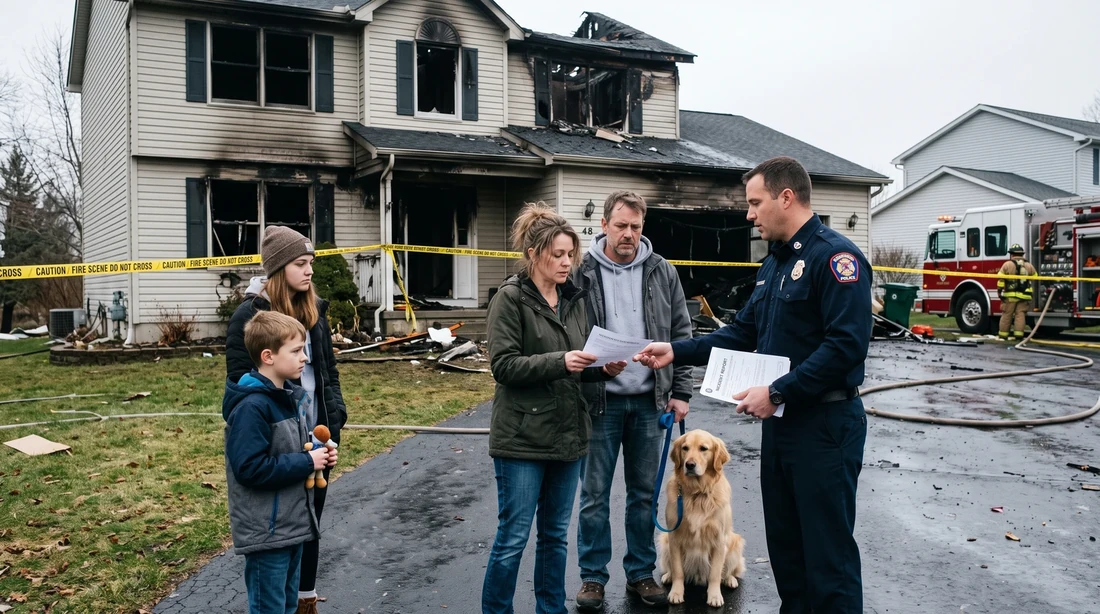
Do not re-enter the house until the fire department clears it. Even a structure that looks fine can have hidden hot spots, weakened floors, or unsafe air. If crews are still on scene, ask the officer in charge for the incident or report number before they leave. Your adjuster will ask for it, and it's much easier to get now than to chase later.
If you must retrieve medications, glasses, IDs, or a child's essentials, ask whether a firefighter can escort you or bring items out. Never go back in alone on day one.
If you couldn't retrieve prescriptions, call your pharmacy first thing. Pharmacies can typically issue emergency refills after a documented house fire, and your prescriber can authorize replacements for anything controlled. Keep those receipts; medication replacement tied to the loss belongs in your claim file.
Two organizations can help before your carrier's money arrives. The American Red Cross responds to home fires with immediate short-term assistance, and the responding fire crews can often connect you the same night. And if you have nowhere to sleep tonight, friends and family are a legitimate day-one answer; nothing about the claim requires you to book a hotel in hour one.
Then make the claim call, the same day, even if it's late. Have three goals for that call:
- Get your claim number and write it on everything from here forward.
- Get your adjuster's name and direct contact, plus when they'll reach out.
- Ask about your ALE (Additional Living Expenses) coverage, including what your loss-of-use limit is and whether the carrier can issue an advance for immediate lodging, meals, and essentials.
If you rent rather than own, the same-day calls go to your renters carrier and your landlord. Your landlord's policy repairs the building, while your renters policy typically covers your belongings and your displacement costs. See does renters insurance cover temporary housing for how that version works, and does renters insurance cover hotel stays for the short-stay specifics.
Before anything is moved, tarped, or thrown away, photograph what you can safely see from cleared areas: wide shots of every room, close-ups of damage. Untouched photos are the strongest documentation you'll ever have on this claim.
Finally, confirm utilities are shut off or ask the fire department whether they already handled gas and electric. A second event at a fire-damaged house is the last thing anyone needs.
If the cause is under investigation
When the fire's origin isn't obvious, the fire marshal, and sometimes your carrier's own origin-and-cause investigator, may restrict access for days. Your claim still opens on day one regardless; the investigation and the claim run in parallel. Cooperate fully, don't speculate about the cause in writing or recorded statements, and ask your adjuster how the access delay affects your board-up and inventory timelines so nothing gets counted against you.
What Should You Do on Day 2? Secure the Site and Open the Paper Trail
Nearly every homeowner policy includes a duty to mitigate: you're expected to take reasonable steps to prevent further damage after the fire. Practically, that means board-up service for broken windows and doors and tarping for any roof openings.
Call your adjuster first: many carriers will dispatch or authorize an emergency mitigation vendor directly, which keeps the cost inside the claim cleanly. If you have to arrange it yourself, get an itemized invoice and photos of the completed work. Reasonable emergency measures are typically reimbursable.
Season changes what "secure" means in Oklahoma. In spring and summer, an open roof plus one metro thunderstorm turns smoke damage into water damage overnight, so tarping is the urgent item. In a winter freeze, ask the fire department or your mitigation crew whether the plumbing needs to be drained or winterized once utilities are off; a burst pipe in a vacant, unheated fire house is a classic secondary loss that becomes a coverage argument.
Two more cautions for day two. First, don't sign a full restoration or rebuild contract this early; emergency board-up is urgent, but the big contract deserves multiple bids and your adjuster's estimate in hand. Second, be careful with anyone who shows up at the scene unsolicited asking you to sign paperwork, take a card, and decide later.
Day two is also when your paper trail becomes a system. Set up three containers: a physical folder or envelope for paper receipts, a dedicated photo album on your phone, and an email folder for everything digital. Every lodging folio, restaurant receipt, pharmacy run, and pet-boarding charge goes in. ALE reimbursement rises or falls on receipts. "Additional" expenses only count if you can show them.
Request a copy of the fire or incident report through Oklahoma City Fire Department records if your fire was in the city. It usually takes a few days to become available, so filing the request early keeps it off next week's list.
| Days | Top priorities | Why it can't wait |
|---|---|---|
| Day 1 | Safety, incident number, claim call, ALE advance request | Prompt notice is a policy condition; advances take days to process |
| Day 2 | Board-up and tarping, receipt system, fire report request | Unsecured homes invite secondary damage and mitigation disputes |
| Days 3-4 | ALE advance follow-up, housing decision, mortgage servicer call, mail forwarding | Nightly hotel rates burn the ALE pool faster than any other choice |
| Days 5-6 | Contents inventory, restoration bids, document replacement, school and pet logistics | Contents payments typically wait on your inventory |
| Day 7 | Submit first receipts packet, confirm 30-day housing plan | Weekly submissions keep reimbursements flowing instead of stacking up |
What Does Waiting Cost You in Week One?
Every day without a plan converts into either unreimbursed spending or a smaller ALE pool later. Here's the sequence when a displaced family drifts instead of deciding:
- Nights 1-3: Walk-in hotel rates, every meal out, and no receipt system. Money spent without documentation is money that typically never comes back through the claim.
- By day 4: An unsecured house sits exposed to weather and theft, and secondary damage can turn into a dispute over whether you met your duty to mitigate.
- By day 7: No ALE advance requested means everything is still floating on your credit card while reimbursement paperwork hasn't even started.
- By week 3: Two hotel rooms with no kitchen or laundry are draining the ALE pool at nightly rates, and restaurant meals for five compound the burn daily.
- By month 2: The rebuild timeline slips (they usually do), and the family discovers the ALE limit has to stretch further than the spending pace allows. If the pool runs dry before the house is done, the remainder is out of pocket.
Displaced by a fire in the OKC metro? We place families in furnished, pet-friendly homes on monthly rates that work with ALE claims — often within days, not weeks. Start an insurance housing request or call/text (405) 870-2146.
What Happens on Days 3-4? The ALE Advance, the Mortgage Call, and Your Housing Decision
ALE covers the additional costs of living displaced, amounts above what your household normally spends. A hotel bill is additional. Your regular grocery run isn't. The difference between restaurant meals and your normal food budget typically is. Laundry service, pet boarding, and extra commuting mileage often qualify too. How the coverage is calculated and capped is explained in loss of use coverage explained.
If you haven't received an advance by day three, follow up in writing with a short email to your adjuster asking for an ALE advance against your loss-of-use coverage, referencing your claim number. Written requests create a record and tend to move faster than phone tag.
Call your mortgage servicer this week too, even though it feels premature. Because of the mortgagee clause in your policy, checks for dwelling repairs are commonly made out to both you and your lender, and every servicer has its own endorsement and draw process, some of which take weeks. ALE payments, by contrast, are typically payable to you alone. Learning your lender's process on day three prevents a five-figure repair check from sitting unendorsable at month two.
If you have school-age kids, call the school this week as well. Metro districts (OKCPS, Edmond, Moore, Putnam City, Deer Creek and others) generally have processes for families temporarily displaced from their home address, and many will keep a child enrolled at their current school during a rebuild. Where you can, weigh temporary housing that keeps the same drive to school and work; a four-month stay across the metro from both adds a daily cost no one reimburses.
Days three and four are also when the housing question stops being tonight's problem and becomes a duration problem. The honest fork: if repairs will take under two weeks, a hotel is usually fine. If your contractor is saying months, nightly rates are the most expensive possible way to wait.
| Option | Typical monthly cost | 4-month total |
|---|---|---|
| Two hotel rooms (~$165/night each) | ~$9,900 | ~$39,600 |
| Two extended-stay suites (~$120/night each) | ~$7,200 | ~$28,800 |
| Furnished 4-bedroom home, monthly rate | ~$4,200 | ~$16,800 |
Figures are illustrative and exclude pet fees, parking, and meal differences, which typically widen the gap further, since hotels add pet charges nightly and offer no kitchen. The full option-by-option breakdown lives in our temporary housing after a house fire guide.
A worked example: family of five, a dog, and a 4-month rebuild
Say, hypothetically, a kitchen fire displaces a family of five with a dog, and the contractor estimates four months of restoration.
Two hotel rooms at roughly $165/night each run about $330/night, or ~$9,900/month, around $39,600 over four months before pet fees and eating out. Restaurant meals for five above a normal grocery budget could add in the ballpark of $2,500-$3,500 per month on top.
A furnished four-bedroom, dog-friendly home at $4,200/month runs $16,800 over the same four months, with a kitchen and laundry that pull the meal and laundry line items back toward normal. The lodging difference alone, roughly $22,800, stays in the ALE pool as a cushion for the rebuild delays that almost always happen.
Variant: the rebuild slips to six months
Now stretch the same hypothetical family's rebuild to six months, common when permits, material orders, or a busy storm season intervene. The hotel path becomes $9,900 × 6 = $59,400; the furnished home becomes $4,200 × 6 = $25,200. Suppose the policy's loss-of-use limit is a hypothetical $40,000 (20% of a $200,000 dwelling limit).
The hotel path exhausts that pool around month four, leaving two months of housing entirely out of pocket, while the furnished path finishes at $25,200 with roughly $14,800 still available for meal differences, mileage, and pet costs. Same fire, same family, same policy: the week-one housing decision is the difference.
Variant: it's only a two-week smoke remediation
Flip the timeline the other way. If the same family's damage is light and remediation runs 14 days, two hotel rooms at ~$330/night total about $4,620, and a hotel is the right call. Setting up monthly housing for a two-week stay adds friction with no payoff. The 30-night line is the honest threshold where the math flips.
Some carriers and their housing partners (TPAs) will even bill a furnished home directly with authorization; how that arrangement works is covered in how ALE housing companies work.
What Happens on Days 5-7? Contents Inventory, Restoration Bids, and Settling In
The contents inventory is the biggest single document of your claim, and it's better started in week one while memory is fresh. Work room by room: video walkthroughs first, then photos, then a written list with brand, age, and approximate purchase price where you know them. Photograph serial numbers on electronics and appliances.
If the loss is total (the structure a write-off rather than a repair), the inventory changes shape: you're reconstructing rooms from memory, old photos, and purchase records instead of walking them. Pull bank and card statements, order histories, and cloud photo libraries early; they're the raw material. Ask your adjuster whether your contents coverage pays replacement cost or actual cash value, because the answer changes what documentation earns you.
Do not throw damaged items away until your adjuster has seen or documented them. Discarded items are the hardest thing to get paid for. If something is a health hazard, photograph it thoroughly from multiple angles before it goes.
Smoke-damaged clothing and textiles are their own line: specialty cleaning is often claimable, so get an itemized invoice from the cleaner rather than a lump-sum ticket, and let the adjuster rule on anything the cleaner says is unsalvageable before you toss it.
Get at least two, ideally three, itemized restoration bids this week. You're not signing yet. The bids give you bargaining room and a reality check against the adjuster's estimate when it arrives.
Household logistics round out the week: file USPS mail forwarding to your temporary address, gather your dog's vaccination records for whatever housing or boarding you choose, and notify your employer, bank, and any deliveries.
Replacing documents destroyed in the fire
If IDs and records burned, start replacements this week. Several have multi-week processing times, and you'll need the IDs to do everything else on this list.
| Document | Where to replace it | Notes |
|---|---|---|
| Oklahoma driver's license / state ID | Service Oklahoma | Do this first; it unlocks the rest |
| Birth certificates | Oklahoma State Department of Health, Vital Records | Needed for school and passport replacements |
| Social Security cards | Social Security Administration | Replacement is free; never pay a third party |
| Passports | U.S. Department of State | Report the old one lost/destroyed when applying |
| Vehicle titles | Service Oklahoma | Lienholder may hold the title already; check first |
| Insurance policy documents | Your carrier or agent | Reissued on request; ask for the full policy, not the summary |
On day seven, submit your first receipts packet to your adjuster: everything from the week, itemized, with your claim number. Then keep a weekly cadence. Weekly submissions keep money flowing back to you instead of building into one contested pile at month three.
| Task | Who owns it | Proof to keep |
|---|---|---|
| Report the loss | You | Claim number, adjuster name and direct line |
| Board-up and tarping | Carrier-dispatched vendor, or you with authorization | Itemized invoice, before/after photos |
| Fire/incident report | You (request from OKC Fire Department records) | Copy of the report |
| ALE advance | Adjuster and carrier | Written request and confirmation email |
| Mortgage check endorsement | You and your loan servicer | Servicer's written draw/endorsement process |
| Contents inventory | You; adjuster verifies | Video, photos, serial numbers, written list |
| Temporary housing setup | You, or an ALE housing provider | Rate agreement, folios/invoices |
| Direct billing authorization | Carrier or TPA | Written authorization |
| Repair estimates | Restoration contractors; adjuster reviews | Two to three itemized bids |
How Do You Handle the First Week After a House Fire? Step by Step
- Confirm safety and get the incident number. Keep everyone out of the structure until the fire department clears it, and write down the incident or report number before crews leave the scene.
- Call your carrier and open the claim. Report the loss the same day, and record your claim number, your adjuster's name and direct line, and what your policy's ALE limit is.
- Request an ALE advance in writing. Ask your adjuster for an advance against your loss-of-use coverage so hotel nights, meals, and essentials don't come out of pocket.
- Secure and document the property. Authorize board-up and tarping through your carrier when possible, and photograph every room before anything is moved or discarded.
- Save every receipt from hour one. Keep lodging, meal, pet-boarding, and essentials receipts in one folder. ALE reimbursement typically rises or falls on this paper trail.
- Lock in 30-day-plus housing by day 7. If the rebuild will run a month or more, move from nightly hotel rates to monthly furnished housing so your ALE pool lasts the whole repair.
When Is a Hotel Enough, and When Isn't It?
If your restoration is a two-week smoke remediation, a hotel or extended-stay is often the right call. It is fast, simple, and done before monthly housing makes sense. A single displaced adult with a short repair window rarely needs more, and if you hold serious hotel points, a short stay may cost you nearly nothing while the claim catches up.
The math flips when the stay crosses roughly 30 nights, when there are more people than one room holds comfortably, or when a pet turns every hotel into a nightly-fee negotiation. A household of five with a dog and a four-month rebuild needs bedrooms, a kitchen, laundry, and a yard, which hotels can't offer at any price.
That's the situation BnB OKC exists for: 11 furnished homes across the OKC metro, sleeping 2 to 16+, several of them dog-friendly, with monthly rates on 30+ night stays and experience working with carriers and Alacrity Solutions on insurance placements. The homes sit in livable parts of the metro (near Lake Hefner, The Village, and the Paseo and Plaza districts), so a displaced household keeps its commutes and routines instead of relocating its whole life.
Guests rate us 9.5 out of 10 across 1,580 verified reviews on Airbnb and Vrbo. Browse pet-friendly rentals in OKC or our extended-stay homes, and if you book direct, stays of 4+ nights save up to 35% versus platform pricing.
And if your carrier pushes back on housing at any point, don't accept the first "no" as final. insurance denied temporary housing walks through the escalation path.
Terms You'll Hear, Decoded
- ALE (Additional Living Expenses): the part of your policy that pays displacement costs above your normal cost of living.
- Loss of use: the coverage section ALE lives under, triggered when a covered loss makes your home unlivable.
- Duty to mitigate: your obligation to take reasonable steps (board-up, tarping) to prevent further damage after the loss.
- ALE advance: money the carrier pays up front against your loss-of-use limit so you're not floating expenses on credit.
- Contents inventory: your itemized list of damaged belongings, the document contents payments are built on.
- Replacement cost vs. actual cash value (ACV): replacement cost pays what a new equivalent item costs; ACV subtracts depreciation. Your policy says which applies to contents.
- Mortgagee clause: the policy provision that puts your lender's name on dwelling-repair checks, which is why the servicer call happens in week one.
- Direct billing: a housing provider invoicing your carrier or its TPA directly, which happens only with written authorization.
- Proof of loss: the formal, signed statement of your claimed damages; your carrier may require it within a set window.
For consumer help with a homeowners claim in Oklahoma, the Oklahoma Insurance Department offers guidance and a complaint process. Fire report requests and city services are handled through the City of Oklahoma City, and immediate post-fire assistance is available through the American Red Cross.
Your Next Steps
- Confirm your claim basics today: claim number, adjuster's direct contact, and your policy's loss-of-use limit. Write all three in one place.
- Start the paper trail tonight: one folder for receipts, one phone album for photos, and a written ALE advance request to your adjuster. Then add the mortgage-servicer call to tomorrow's list.
- If the rebuild will run 30+ days, line up monthly furnished housing before hotel nights eat the budget: start an insurance housing request or call/text (405) 870-2146.
Bottom Line
Call your carrier the same day, get the claim number and your adjuster's direct line, and ask for an ALE advance in writing. Secure the house, photograph everything before it moves, and save every receipt from hour one. If the rebuild will run a month or more, get out of nightly hotel rates by day 7 so the ALE pool lasts.
This guide is general information, not insurance or legal advice; your carrier makes all coverage decisions.