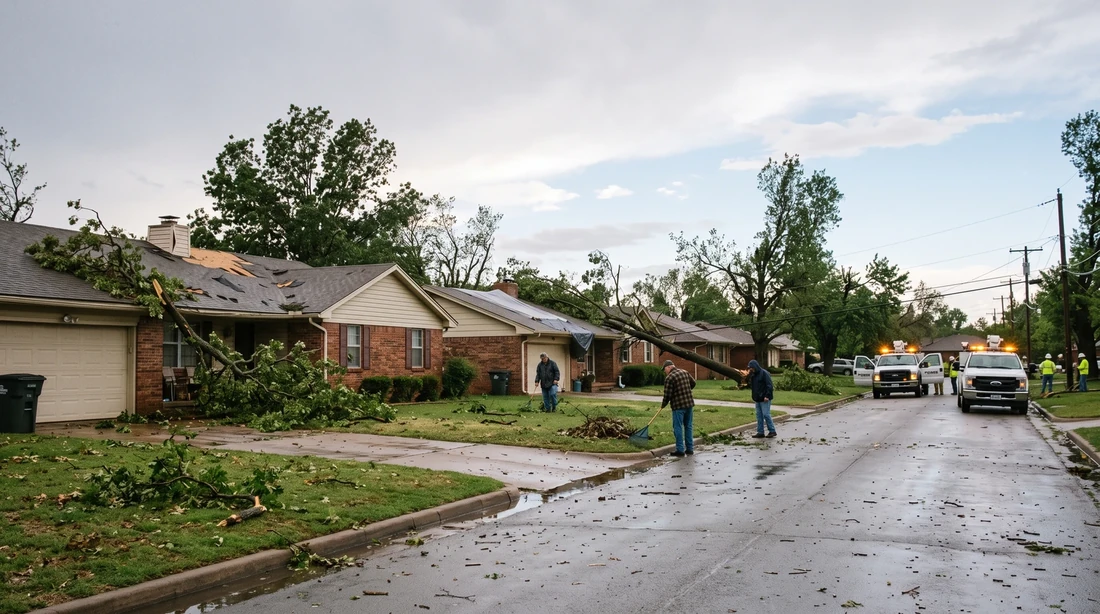
What to do after a tornado: confirm everyone is safe and the structure is stable; photograph all damage before any debris is moved; call your insurance carrier to open a claim and ask about Additional Living Expenses (ALE); then arrange temporary housing and keep every receipt. Contractor signatures come after the photos — never before.
Key Takeaways
- Work in order: confirm safety, photograph everything, call your carrier, mitigate further damage, then arrange housing — contractor signatures come after the photos.
- Photograph before cleanup, because debris crews can haul away evidence within days, and rain through an untarped roof turns wind damage into water damage.
- For two adults, a standard hotel typically runs $4,000 to $4,700 monthly, while a furnished home on a monthly rate typically runs $3,000 to $5,500 by size.
- With a mortgage, the dwelling settlement check is often payable to you and your lender; ALE payments are typically payable to you alone.
This guide covers the first days after a tornado hits your home in the OKC metro: staying safe, photographing damage before cleanup, opening the insurance claim, finding somewhere to live during repairs, and spotting storm-chaser contractors.
The sirens stopped, you came up from the shelter, and half your roof is scattered across the neighbor's yard. It's disorienting. That's exactly when the most expensive mistakes happen. The order you do things in over the next 72 hours shapes your claim, your repair timeline, and where you sleep for the next two months.
Two real clocks start the moment the storm passes: your policy's duty to prevent further damage begins immediately, and debris crews (city, volunteer, or contractor) can haul away your photographic evidence within days. Shoot photos and video of everything before anything is moved.

What Should You Do in the First 24 Hours After a Tornado?
The most dangerous hour after a tornado is often the first hour back on your property. Downed power lines, gas leaks, and shifted framing injure people every Oklahoma storm season, long after the funnel is gone.
Before you go back inside, work through this safety sweep:
- Treat every downed line as live. Don't step over one, don't move one with a broom handle, and report it to your utility.
- If you smell gas, get everyone away from the house and call your gas utility from a distance. Don't flip switches or light anything.
- Look at the structure before you enter. Leaning walls, a sagging roofline, or doors that suddenly won't close are signs the frame has moved.
- Wear thick-soled boots and gloves. Nail-studded lumber and broken glass cause a huge share of post-storm injuries.
- Run generators outdoors only, far from windows. Carbon monoxide is invisible and fast.
If any part of the structure has shifted, stay out until a professional clears it. If the home is safe to enter briefly, grab medications, IDs, insurance documents, phone chargers, and a few days of clothes. Then get back out and let the documentation phase begin. In tornado season, which peaks in Oklahoma from April through June, more storms can follow the first one, so know where you'll shelter tonight before dark.
Three unglamorous calls in the first day or two save headaches later. Put a hold or forward on your mail with USPS so claim correspondence doesn't sit in a damaged mailbox. Pause internet and trash service at the address if you'll be out for weeks. And if the storm pulled the meter base or weatherhead off the house, tell your electric utility. Utilities typically require a licensed electrician to repair the mast before they'll reconnect power, and that trade backlogs fast after a metro-wide storm.
Beyond your policy, federal disaster programs may also help:
Mortgage help and home repair loans after a disaster If you live in a presidentially declared disaster area, you may be eligible for mortgage assistance or financial help to repair or rebuild your home.
USAGov: Financial assistance after a disaster
Should You Clean up Before the Adjuster Comes?
Photograph first, mitigate second, discard nothing. Photographs taken before debris removal are the single most valuable asset in a tornado insurance claim. Once the pile leaves the curb, the evidence leaves with it.
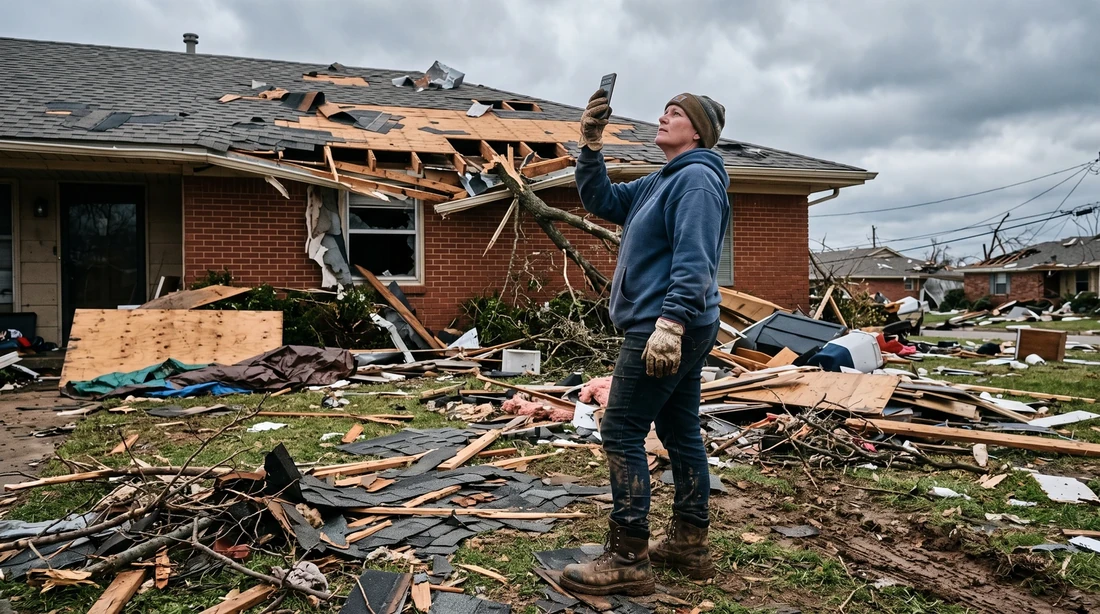
Shoot more than feels necessary. A useful documentation set includes:
- Wide shots of all four exterior sides, plus the roof from the ground at each corner.
- Every room, corner to corner, even rooms that look untouched. Interior water damage shows up later.
- Close-ups of damaged contents: furniture, electronics, clothing, the fence, the shed, vehicles.
- Model and serial plates on appliances and electronics.
- The refrigerator and freezer contents before you toss them. Many policies include a modest food-spoilage allowance after a power loss, and it's the easiest line item to forget.
- A narrated video walk-through where you say the date out loud and describe what you're seeing.
Then call your carrier and open the claim. Ask three questions on that first call: what is my ALE limit, are my emergency tarping and board-up costs reimbursable, and do you authorize direct billing for temporary housing? Write down the claim number and your adjuster's name. If the term is new to you, our guide to loss of use coverage explains how the housing portion of your policy typically works.
You can (and typically must) take reasonable steps like tarping the roof or boarding windows, and those costs are often reimbursable with receipts. Don't discard anything until your adjuster has documented it or approved it in writing. If something must go for safety, like soaked carpet or spoiled food, photograph it thoroughly and keep a cut sample where practical. You can't re-photograph what's already at the landfill.
One wrinkle surprises homeowners. If you have a mortgage, the dwelling portion of your settlement check is often made payable to both you and your lender. The lender endorses it and typically releases funds in draws as repairs pass inspection, so call your mortgage company's loss-draft department early to learn their process. ALE payments, by contrast, are typically payable to you alone, which is why keeping the housing receipts clean matters so much.
If the vehicle took a hit too, that's a separate claim. Photograph the car where it sits before it's towed, and file the auto claim the same day as the home claim.
What Does Waiting Cost You After Tornado Damage?
Delay after a tornado compounds in a predictable sequence, and each stage of waiting costs you real money or real bargaining power.
- Hours 1 to 12: Rain through an untarped roof turns wind damage into water damage. Many policies expect you to take reasonable steps to prevent further loss, and disputes over "neglect" start here.
- Days 1 to 2: Storm-chaser crews canvass the hardest-hit streets first. A pressured signature on day two becomes a contract dispute in week six.
- Days 2 to 5: Debris removal begins with city crews, volunteers, and neighbors with trailers. Anything you didn't photograph is gone for good.
- Week 1: Hotels and extended-stays across the metro fill fast after a large tornado. The later you book, the farther from your home and repair crew you'll end up.
- Weeks 2 to 8: Every unnecessary hotel night draws down a capped ALE budget that a monthly rate would stretch. The cap doesn't grow because the repair ran long.
| Stage | What's happening | Your move |
|---|---|---|
| Hours 0–24 | Utilities may be down; structure unassessed; more storms possible | Safety sweep, full photo set, first call to your carrier |
| Days 1–3 | Storm-chaser crews canvass; carrier assigns an adjuster | Tarp and board up (keep receipts); book a short-term room; sign nothing at the door |
| Week 1 | Adjuster inspects; neighborhood debris pickup begins | Walk the inspection with your adjuster; get your ALE limit in writing |
| Weeks 2–4 | Estimates and repair scope settle; contractor backlogs grow | Vet contractors; move from nightly hotel rates to a monthly-rate furnished home if repairs will run 30+ days |
| Weeks 4–8+ | Repairs underway; ALE budget draws down | Track spend against your ALE cap; get repair milestones in writing; extend housing early if timelines slip |
How Long Do Tornado Repairs Take?
Roof and siding repairs often run two to six weeks once materials arrive. Structural rebuilds can take four to twelve months. After a metro-wide storm, contractor and materials backlogs stretch every timeline, so get milestone dates in writing and plan housing in 30-day blocks with an option to extend. Displaced households underestimate the repair window more often than not, and spring repairs can pause for new storms.
Displaced by tornado damage in the OKC metro? We place displaced households in furnished homes on documented monthly rates and work with adjusters and Alacrity Solutions on insurance placements. Same-day options: call or text (405) 870-2146 or start at our insurance housing page.
Where Will You Live During Repairs?
For a 6 to 8 week tornado repair, a furnished home on a monthly rate typically costs less than a comparable hotel stay. It also gives you a kitchen and laundry that keep your other ALE spending down.
The mechanics of ALE reimbursement, direct billing, and carrier authorization live on our insurance housing hub and in how ALE housing companies work. The short version: ALE typically pays costs above your normal living expenses (lodging, extra meals, pet boarding) up to a cap, and receipts substantiate everything.
If you rent, the building is your landlord's problem. Your housing is yours, and that's the loss-of-use line on your own renters policy. The rules differ enough that we cover them separately in does renters insurance cover temporary housing and does renters insurance cover hotel stays.
| Option | Ballpark monthly cost (two adults) | What you get | What disqualifies it |
|---|---|---|---|
| Standard hotel | Typically $4,000–$4,700 ($135–$155/night) | Housekeeping, no commitment | No kitchen or laundry; pet fees add up; rooms scarce after a metro-wide storm |
| Extended-stay hotel | Typically $2,700–$3,900 | Kitchenette, weekly housekeeping | One cramped room for 6–8 weeks; often booked out within days of a major tornado |
| Furnished home (monthly rate) | Typically $3,000–$5,500 by size | Full kitchen, laundry, yard, real bedrooms, driveway parking | Usually requires a 30+ night commitment |
Our 11 furnished homes across the OKC metro sleep 2 to 16+, with published from-rates of $225 to $425/night, monthly rates on 30+ night stays, and several dog-friendly options. See our pet-friendly rentals in OKC and extended stays. We average 9.5 out of 10 across 1,580 verified guest reviews on Airbnb and Vrbo, and booking direct saves up to 35% on 4+ night stays.
Why does staying near your own neighborhood matter in OKC?
During a 6 to 8 week repair you'll be back at the house two or three times a week: walking the adjuster's inspection, letting the roofer in, checking the dry-out equipment, sifting salvage from the debris pile. Oklahoma City alone covers roughly 620 square miles, so a room across the metro can add 30 to 40 minutes each way, several times a week, for two months.
Pick housing by drive time to the repair, not by the first vacancy you find. Our homes sit near Lake Hefner, The Village, and the Paseo and Plaza districts, with one six minutes from Will Rogers World Airport on the southwest side. Capitol Manor is directly across from OU Medical Center and OU Children's Hospital if the storm put someone in your household in the hospital.
If you have school-age kids, staying inside or near your district avoids a mid-repair transfer. Federal law (the McKinney-Vento Act) generally lets students displaced by disaster stay enrolled in their school of origin. Ask your district's homeless-education liaison how transportation works while you're out of the house.
What happens when OKC hotels are already full?
Oklahoma's tornado peak, April through June, overlaps the metro's busiest event weeks, so displaced households often compete with visitors for the same rooms.
| When | What's on the OKC calendar | What it means after a storm |
|---|---|---|
| Late April | OKC Memorial Marathon — during peak tornado season | Downtown and midtown hotels fill weeks ahead; displaced families get pushed to the metro's edges |
| Late May–early June | Women's College World Series at Devon Park | Softball fans book metro hotels solid at the exact height of storm season |
| September | State Fair of Oklahoma | Extended-stays near the fairgrounds tighten for weeks |
| October–April | Thunder home games at Paycom Center | Downtown nightly rates spike on game nights — brutal for week-to-week hotel stays |
A furnished home on a locked monthly rate sidesteps all of it. No game-night surge pricing, and no getting bumped when a tournament block takes the floor.
What does displacement cost? Three hypothetical examples
These scenarios are hypothetical, but the arithmetic is real. Screenshot the one that matches your household.
Scenario 1, a couple for seven weeks. Say a tornado peels the roof over your kitchen and a severed supply line floods the downstairs overnight. The contractor quotes seven weeks and your carrier confirms ALE applies.
- Hotel path: a room at $145/night × 49 nights = $7,105. Add roughly $30/day in restaurant meals above your normal grocery spend = $1,470. Total: about $8,575 drawn against your ALE cap.
- Furnished-home path: a two-bedroom at a $3,400 monthly rate. 49 nights ≈ 1.63 months, so $3,400 × 1.63 ≈ $5,553. You're cooking in a real kitchen, so the extra-meals line stays near zero.
That's roughly $3,000 of ALE headroom preserved. The same math applies to fire displacement; see temporary housing after a house fire.
Scenario 2, a household of five with a dog for eight weeks. One hotel room doesn't work, so the hotel path means two rooms at $145 each: $290/night × 56 nights = $16,240. Add pet fees around $25/night = $1,400, plus roughly $60/day in extra meals for five people = $3,360. Hotel total: about $21,000. A furnished four-bedroom at a hypothetical $5,200/month runs $5,200 × 1.87 months ≈ $9,700, plus perhaps a one-time pet fee. Call it $9,950, with a fenced yard instead of nightly dog fees. That's roughly $11,000 of cap preserved.
Scenario 3, when the cap itself is the problem. Suppose a policy sets loss of use at 10% of a $180,000 dwelling limit, for an $18,000 ALE ceiling. The household-of-five hotel path above burns through that cap before the eight-week repair even finishes, and week nine comes out of pocket. The furnished-home path at ~$9,950 leaves nearly half the cap intact for a timeline slip.
And repairs slip. If scenario 1's couple runs seven weeks to ten, the hotel path adds $145 × 21 nights + $630 in meals = $3,675 more (total ≈ $12,250), while the monthly rate adds 0.7 month × $3,400 = $2,380 (total ≈ $7,933). The cap is fixed and the repair timeline isn't. Your carrier sets your actual limit, so get it in writing before choosing a path.
How to Handle Tornado Damage, Step by Step
If you remember nothing else from this page, work this sequence in order:
- Confirm safety. Check for gas odors, downed power lines, and shifted framing before you re-enter, and stay out of any structure that looks unstable.
- Photograph everything. Take wide shots of every exterior side and every room, plus close-ups, before anything is moved or tarped over.
- Call your carrier. Open the claim, ask about your ALE limit, and write down your claim number and adjuster contact.
- Mitigate further damage. Tarp the roof, board broken windows, and shut off water at the main. Keep every receipt.
- Arrange ALE housing. If repairs will run 30+ days, book somewhere with a kitchen and laundry at a documented monthly rate.
- Vet every contractor. Verify Oklahoma roofing registration and never sign an assignment of benefits on your doorstep.
How Do You Spot a Storm-Chaser Contractor?
Out-of-town repair crews reach hard-hit Oklahoma neighborhoods within 24 to 48 hours of a major tornado. Telling legitimate roofers from storm chasers is a claim-saving skill.
Red flags that should end the conversation:
- Door-to-door pressure to sign the same day, "before the price goes up."
- Offers to waive or "absorb" your deductible. That's a classic fraud flag that can put your whole claim at risk.
- Demands for a large payment up front, in cash.
- No verifiable physical Oklahoma address or local references from previous seasons.
- No registration number. Oklahoma generally requires roofing contractors to register with the state's Construction Industries Board, so ask for the number and verify it before signing anything.
- A contract that includes an assignment of benefits, handing the contractor control of your insurance claim.
Never sign an assignment of benefits on your doorstep. Get two or three written estimates instead, confirm liability insurance and workers' comp, pay in stages tied to completed milestones, and match the contractor's scope to your adjuster's estimate. Legitimate contractors don't need a signature in your driveway.
Spring repairs bring one more problem. Work during April through June happens while storm season is still active, so ask how the crew tarps and secures the open roof between work days. A second hailstorm on an unprotected deck can restart the whole claim conversation. If something feels off, report it. The Oklahoma Insurance Department takes fraud reports and can tell you if complaints exist against a company.
When Does FEMA Registration Apply?
FEMA Individual Assistance is only available when the President issues a major disaster declaration covering your county. Many Oklahoma tornadoes, even destructive ones, never reach that threshold.
If a declaration does come, register promptly at DisasterAssistance.gov, by phone, or through the FEMA app. Registration is free and doesn't hurt your claim. You'll be asked for your insurance information first, because FEMA assistance never duplicates what insurance pays. It exists for uninsured and underinsured needs: some temporary housing help, certain repairs, and referrals to low-interest SBA disaster loans for bigger gaps.
Register even if you're fully insured. If your settlement falls short or coverage is denied on part of the loss, being registered early keeps the door open. Keep every carrier letter, including denials, because FEMA typically needs your insurer's determination before paying most assistance. If the city hasn't yet published debris-collection schedules for your neighborhood, check okc.gov rather than assuming a pickup date.
What If Your Insurer Denies or Cuts off Housing?
Get the denial in writing with the specific policy language cited, then ask your adjuster exactly what documentation would change the determination. Habitability disputes are common, and a home without power, water, or a weather-tight roof is a strong ALE case. If it stalls, you can file a complaint with the Oklahoma Insurance Department. Our guide to insurance-denied temporary housing walks the full escalation path.
Who Handles What During a Tornado Claim?
A tornado recovery involves at least four parties: you, your adjuster, your carrier, and your housing host. Knowing which task belongs to whom keeps things from falling through the cracks.
| Task | Who owns it | Timing |
|---|---|---|
| Photograph and video all damage | You | Before any cleanup — day one |
| Emergency tarping and board-up | You (invoices typically reimbursable) | First 24–48 hours |
| Claim setup and adjuster assignment | Carrier | Days 1–3 |
| Inspection and damage estimate | Adjuster | Typically week 1–2; longer after a metro-wide event |
| ALE limit confirmation in writing | Carrier (you request it) | With claim setup |
| Mortgage loss-draft process for the dwelling check | You and your lender | As soon as a settlement is discussed |
| Temporary housing search and booking | You, or an ALE housing company | Days 1–7 |
| Direct billing setup | Carrier/TPA and host, after authorization | Once housing is approved |
| Contractor vetting and repair contract | You, matched to the adjuster's scope | Weeks 2–4 |
| Weekly ALE receipt tracking | You | Every week until you're home |
What Receipts Should You Keep for ALE?
Keep every receipt tied to displacement: lodging invoices, restaurant meals beyond your normal grocery spend, laundry, pet boarding, and extra fuel from a longer commute. ALE reimburses the additional amount above your normal cost of living, so carriers compare against your baseline. A phone photo album or folder you update weekly beats reconstructing two months of spending at settlement time.
When Do You Need Temporary Housing at All?
Plenty of tornado claims never need ALE housing, and it helps to know which kind you have before you book anything.
You probably don't need us if the home is still livable, with power and water on, the roof weather-tight over the sleeping areas, and damage confined to a fence, garage, or a single room. You also don't need a furnished home for a one- or two-week repair. An extended-stay hotel handles that fine, especially for a single adult with hotel points.
If nearby relatives can absorb your household comfortably, a free week with family is often the smartest first move, since it costs your ALE cap nothing while the repair scope settles. And if the total damage lands near your deductible, ALE may barely come into play.
A furnished home changes the outcome when the displacement runs 30+ nights or when pets are involved (hotel pet fees compound nightly; several of our homes are dog-friendly with fenced yards). It also wins when the household needs two or more hotel rooms to sleep everyone, which is where the monthly-rate math flips hard, as scenario 2 shows. Same if you need a full kitchen, laundry, and space to work from home for two months. At that point the monthly rate is budget protection against a capped ALE limit and a repair timeline that only ever slips one direction.
Terms You'll Hear, Decoded
- Additional Living Expenses (ALE): the part of your policy that reimburses costs above your normal cost of living while your home is uninhabitable.
- Loss of use: the policy section ALE lives under, often capped at a percentage of your dwelling coverage.
- Habitability: the carrier's judgment call on whether the home is fit to live in. No power, no water, or no weather-tight roof over sleeping areas are the usual triggers.
- Duty to mitigate: your obligation to take reasonable steps (tarping, board-up, water shutoff) to prevent further damage after the loss.
- Proof of loss: the sworn, itemized statement of damage your carrier may require to finalize the claim.
- Assignment of benefits (AOB): a contract clause that transfers your claim rights to a contractor. It's the storm chaser's favorite signature.
- CAT adjuster: a catastrophe adjuster brought in after large storms; expect a different name than your usual local contact.
- TPA (third-party administrator): a company your carrier hires to manage parts of the claim, including housing placement. Alacrity Solutions is one we work with.
- Direct billing: the carrier or its TPA paying your housing provider directly, only with the carrier's written authorization.
Bottom Line
Safety first, photos second, then the call to your carrier. Get your ALE limit in writing, since every housing decision hangs on it and scenario 3 above shows how a capped budget punishes the hotel path.
- Confirm your ALE limit with your adjuster today, in writing.
- Gather your evidence: the full photo and video set, your mitigation receipts, your mortgage lender's loss-draft requirements, and two or three written contractor estimates matched to the adjuster's scope.
- Line up housing before the metro fills. Start at our insurance housing page or call/text (405) 870-2146. Tell us your repair timeline and the part of the metro your home is in, and we'll match a furnished home to both.
This guide is general information, not insurance or legal advice; your carrier makes all coverage decisions. For policy complaints or fraud reports, contact the Oklahoma Insurance Department; for federal disaster help after a declaration, start at FEMA's disaster assistance site; for city debris and storm-recovery updates, see the City of Oklahoma City website.