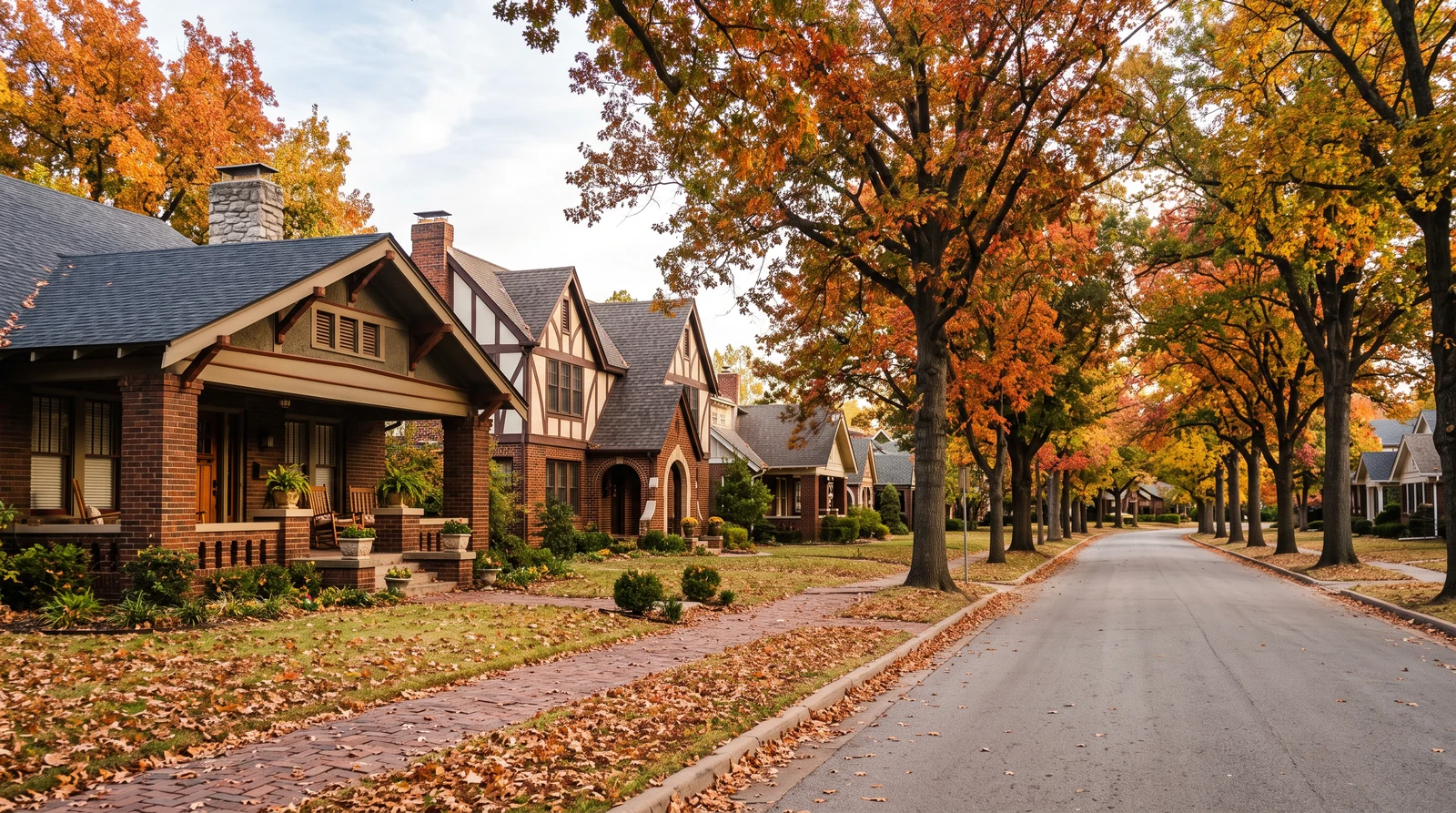
Oklahoma City neighborhoods sort into five bands for a newcomer: the downtown core (Bricktown, Deep Deuce, Midtown), the historic and arts districts just north (Heritage Hills, Paseo, Plaza, Uptown 23rd), the northwest lakes and golf neighborhoods (Lake Hefner, Quail Creek, The Village, Nichols Hills, Gaillardia), the Capitol and OU Health district, and the south side around Capitol Hill and the airport. Pick by commute first, then by weekends.
You took the job, the start date is six weeks out, and the lease you sign next will decide what your mornings look like for a year. Everyone you ask names a different neighborhood and nobody mentions that Oklahoma City covers about 606 square miles, which is the single fact that makes "where should I live in OKC" a commute question before it is anything else.
We manage eleven furnished homes across the city and most of our monthly guests are in exactly your position: in town, working, and shopping for a neighborhood from the inside. This is the overview we give them. It covers the in-city neighborhoods; the suburbs have their own guide at best suburbs of Oklahoma City, and travel nurses choosing by hospital have theirs at best neighborhoods for travel nurses in Oklahoma City.
Lease timing matters more here than price. Many OKC landlords list 30 to 60 days ahead and want a decision within days of a showing, which pushes relocating renters into signing on a neighborhood they have seen once. A furnished month on the ground, with your car and your commute, is the cheapest way to avoid a 12-month mistake.
Why Oklahoma City Neighborhoods Are Harder to Compare Than Most Cities'
Oklahoma City's land area is about 606 square miles by the Census Bureau's count, so neighborhoods that share a ZIP code can be 20 minutes apart. The city grew by annexation in the 1950s and 1960s, which is why two independent municipalities, The Village and Nichols Hills, sit entirely inside it.
That sprawl shapes the whole decision. A downtown job and a Lake Hefner apartment is a 15 to 20 minute drive each way. A Tinker Air Force Base job and a Plaza District rental is 20 to 25 minutes. Neither is bad by big-city standards. The point is that OKC has no neighborhood that is close to everything, so you choose what you want to be close to.
The second thing newcomers miss is how fast the inner neighborhoods have changed. The MAPS sales-tax programs since 1993 rebuilt downtown, and the districts just north of it (Midtown, Automobile Alley, the Paseo, the Plaza, Uptown 23rd) went from vacant to the city's restaurant row in about fifteen years. A friend who left in 2010 is describing a different city.

What Picking the Wrong Neighborhood Costs
A neighborhood mismatch in OKC usually shows up as 40 extra minutes a day in the car or a lease break fee, and both are more expensive than a month of furnished housing spent choosing well. Here is how the mistake compounds.
- Week one: you sign from out of state on a neighborhood a coworker recommended, sight unseen beyond a video tour.
- Month one: the commute is 25 minutes each way in traffic you did not test, or the walkable district you wanted turns out to be a 15-minute drive from where you landed.
- Month three: you have found the neighborhood you actually want, and the lease you are in runs nine more months with a break fee that often runs one to two months' rent.
- Month twelve: you move again, paying movers twice in a year, for a decision a month on the ground would have made once.
The alternative is a 30-day furnished stay in the band you are leaning toward, driving your real commute at your real hours, and signing a lease from inside the city. Our extended stays page covers how the monthly rates work.
Relocating to Oklahoma City and not sure which neighborhood yet? A furnished month in one of our homes lets you test the commute before you sign a year. Monthly rates on 30+ night stays.
Oklahoma City Neighborhoods, Band by Band
The in-city neighborhoods fall into five bands, and the table below is the fastest way to see which one matches your commute and your weekends. Drive times are typical off-peak figures we use with guests; add five to ten minutes at rush hour.
| Band and neighborhoods | What it feels like | Drive to downtown | Suits a commute to |
|---|---|---|---|
| Downtown core: Bricktown, Deep Deuce, Midtown, Automobile Alley, Film Row | Apartments and lofts, walkable to restaurants and the arena, streetcar, nightlife noise on game nights | You are there | Downtown offices, OU Health (5 to 10 min), Film Row and the Innovation District |
| Historic and arts districts: Heritage Hills, Mesta Park, Paseo, Plaza District, Uptown 23rd, Crown Heights | Century-old houses and bungalows, galleries, patios, First and Second Friday events, tree canopy | 5 to 10 minutes | Downtown, OU Health, St. Anthony in Midtown, Capitol complex |
| Northwest lakes and golf: Lake Hefner shore, Quail Creek, Lakeside, The Village, Nichols Hills | Established 1950s to 1970s neighborhoods, big lots, the 9.8-mile lake trail, errands along May and Penn | 15 to 20 minutes | Mercy, INTEGRIS Baptist, Oklahoma Heart Hospital, Memorial Road offices, north Edmond |
| Far northwest: Gaillardia, Deer Creek area, Chisholm Creek corridor | Newer estates and subdivisions, country-club golf, the Memorial Road retail strip, Kilpatrick Turnpike access | 20 to 25 minutes | Memorial Road employers, Edmond, anywhere on the turnpike loop |
| Northeast: Capitol district, OU Health campus, Adventure District edge | The Capitol, state offices, the medical campus, the zoo and museums nearby, mixed housing stock | 5 to 10 minutes | OU Medical Center, state agencies, Tinker (15 to 20 min) |
| South side: Capitol Hill, Stockyards City, Wheeler District, airport area | Historic Hispanic commercial district on SW 25th, the working stockyards, a new riverfront neighborhood with a Ferris wheel, quick airport runs | 5 to 15 minutes | Will Rogers World Airport, the FAA center, downtown from the south |
Two of those bands hold most of our homes. Our Paseo and Plaza houses sit in the arts band, and the Lake Hefner, Quail Creek, Lakeside, Village, and Gaillardia homes cover the two northwest bands. Capitol Manor sits in the northeast band across from OU Medical. Our neighborhoods page shows each one.
The downtown core
Downtown OKC is the one band where you can live without a daily drive, and the trade is apartment living and arena-night crowds. Bricktown is the entertainment district on the canal; Deep Deuce, just northeast, is the old jazz district rebuilt as apartments and townhomes; Midtown has the hospital (SSM Health St. Anthony), restaurants, and the streetcar; Automobile Alley is the Broadway strip of restored dealerships; Film Row is the west end around the Jones Assembly.
Our Deep Deuce OKC, Midtown OKC, Automobile Alley OKC, and Film Row OKC guides go block by block. Thunder nights and concerts change traffic and parking here; if you work downtown and never want to drive, this is the band.
The historic and arts districts
The neighborhoods between NW 13th and NW 36th are where OKC's old housing stock and its restaurant scene overlap, which is why they are the first band most newcomers ask about. Heritage Hills and Mesta Park are the grand old houses north of Midtown, with historic-preservation rules that keep them that way; our OKC historic district rules guide explains what that means for rentals.
The Paseo is a Spanish-revival arts district with a First Friday gallery walk from 6 to 9 p.m.; the Plaza District on NW 16th has murals, independent shops, and a monthly street party; Uptown 23rd is the restaurant corridor with the Tower Theatre; Crown Heights and Edgemere Park are the quieter residential grids just north. See Paseo District Oklahoma City, Plaza District OKC, and Uptown 23rd District OKC. Housing is mostly bungalows and small apartment buildings; yards are small, trees are big, and downtown is ten minutes.
The northwest lakes and golf neighborhoods
Northwest OKC around Lake Hefner is where the city's established residential neighborhoods sit, and it is the band most people mean when they say "a nice part of town." Lake Hefner itself has a 9.8-mile paved loop, sailing, and the East Wharf restaurants.
Quail Creek wraps a golf course east of the lake; Lakeside and the Hefner Parkway corridor run along the water; The Village is an independent city of 1950s ranch houses with everyday errands along May and Penn; Nichols Hills, also its own city, is an upscale enclave with Classen Curve and Nichols Hills Plaza shopping on its edge.
Our Lake Hefner OKC, The Village OKC, and Nichols Hills OKC guides cover each. Commutes to Mercy, INTEGRIS Baptist, and the Memorial Road offices run 8 to 15 minutes from here; downtown is 15 to 20.
The far northwest
Beyond Hefner Parkway and north of Memorial Road, OKC turns into newer subdivisions and estates, with Gaillardia Country Club at the center and the Kilpatrick Turnpike as the commute. Gaillardia is gated golf-course estates; the Deer Creek area to the northwest is newer construction, parts of it inside OKC city limits but served by the Deer Creek school district; Chisholm Creek along Memorial Road is the newest retail and restaurant cluster. This is the band with the most square footage per dollar and the longest downtown drive, 20 to 25 minutes. Two of our largest homes sit in Gaillardia.
The northeast: Capitol and OU Health
The northeast band holds the State Capitol, the OU Health medical campus, and the edge of the Adventure District, which makes it the shortest commute in the city for anyone working at the hospital or for the state. Capitol Manor, our home directly across from OU Medical Center, is about 5 minutes from the hospital and 5 to 10 from downtown.
Housing here is a mix of older neighborhoods and new infill near the campus. The zoo, Science Museum, and Cowboy Museum are ten minutes east. For a medical stay rather than a relocation, our lodging for out-of-town medical treatment guide is the better starting point.
The south side
South of the river, OKC is working districts and quick airport access, and two of them are worth a newcomer's weekend even if you land elsewhere. Capitol Hill along SW 25th is the historic commercial strip of the city's Hispanic community, with some of the best taquerias and bakeries in the city.
Stockyards City is a working western district with live cattle auctions on Monday and Tuesday mornings and Cattlemen's Steakhouse open since the years just after statehood; see Stockyards City OKC. The Wheeler District is a new neighborhood on the river's south bank built around the relocated Santa Monica Ferris wheel; see Wheeler District OKC. Will Rogers World Airport is on this side, and several of our homes are as close as six minutes from it.
Commute Times From Each Oklahoma City Neighborhood Band
The commute table is the one most relocating renters wish they had seen before signing, because OKC's major employers sit in four different corners of the city. Figures are typical off-peak drives; test your own at your real hour before you sign.
| From this band | Downtown and Bricktown | OU Health campus | Mercy, INTEGRIS Baptist, Memorial Rd | Tinker AFB | Will Rogers Airport |
|---|---|---|---|---|---|
| Downtown core | Walk or streetcar | 5 to 10 min | 15 to 20 min | 15 to 20 min | 15 to 20 min |
| Historic and arts districts | 5 to 10 min | 10 min | 12 to 15 min | 20 min | 15 to 20 min |
| Northwest lakes and golf | 15 to 20 min | 15 to 18 min | 6 to 15 min | 25 to 30 min | 25 to 30 min |
| Far northwest (Gaillardia) | 20 to 25 min | 20 min | 8 to 12 min | 30 min | 30 to 35 min |
| Northeast (Capitol, OU Health) | 5 to 10 min | 5 min | 15 min | 15 to 20 min | 20 to 25 min |
| South side and airport | 5 to 15 min | 10 to 15 min | 20 to 25 min | 15 to 20 min | 6 to 15 min |
Read it by column. If your job is on Memorial Road, the two northwest bands win and downtown loses 20 minutes a day. If it is at OU Health or the Capitol, the northeast and arts bands are a ten-minute morning. If it is at Tinker, nothing in the city is under 15 minutes, and the suburbs guide covers Midwest City and Moore, which are closer.
What Changes the Answer: Pets, Kids, Cars, and Weekends
Four practical factors reorder the bands for most newcomers, and none of them shows up on a rent listing.
A dog pushes you toward the northwest bands and the arts districts, where yards and the Hefner trail are, and away from downtown apartments with their elevator walks; all of our homes take up to two dogs for a one-time $150 fee, which is how many relocating guests test that. School-age children push toward the northwest and far northwest, where the lots and the district boundaries are, though school assignment is a question for the districts themselves and we will not guess at it.
One car versus two decides whether downtown is livable; the streetcar covers the core and nothing else, so a two-car household loses nothing by living out. And weekends: if your Saturdays are patios and galleries, the arts band; if they are the lake and the golf course, the northwest; if they are the zoo and the museums, the northeast.
Weather is the same everywhere in the city, with one exception. Tornado season peaks April through June, and a house with an interior closet or a shelter is worth more than a top-floor apartment during it. Ask any landlord where the safe room is before you sign.
A Worked Example: Six Weeks in a Furnished Home Before a Lease, $3,900 a Month
A hypothetical relocating couple spending about $3,900 for a furnished month in the northwest band, then signing a 12-month lease from inside the city, comes out ahead of signing blind if that first blind lease would have been wrong. Here is the arithmetic.
- Path A, sign from out of state: first and last month plus deposit on a hypothetical $1,800 apartment, about $5,400 up front. Three months in, the commute is wrong. Lease break fee of two months, $3,600, plus a second move and a second deposit. Total extra cost of the mistake: in the ballpark of $5,000 to $6,000.
- Path B, furnished month first: one month in a furnished home at a hypothetical $3,900, all utilities and furniture included, driving the real commute from the real neighborhood. Then sign a 12-month lease on the right block. The furnished month costs about $2,100 more than a month of unfurnished rent would have, and the mistake never happens.
Path B wins by $3,000 to $4,000 in this hypothetical, and that is before counting the second set of movers. It only loses if the blind lease would have been right, which is a bet on a neighborhood you have seen on video. Our monthly rates vary by home and season (Brompton Manor, our 16-sleeper near the lake, lists at $6,600 a month); the 3-month rentals in Oklahoma City guide and average rent in Oklahoma City give the longer-stay and unfurnished context. These are illustrative figures; your lease sets the real ones.
How to Choose Your Oklahoma City Neighborhood, Step by Step
- Start from your employer's address. Put it in the commute table and cross off every band over your limit.
- Pick the weekend you want. Patios and galleries, the lake and golf, or the zoo and museums each point to one band.
- Drive the commute at your real hour. Hefner Parkway at 7:45 a.m. and at 2 p.m. are different roads.
- Spend a First Friday in the Paseo and a Saturday at Lake Hefner. Two evenings tell you more than twenty listings.
- Ask about the safe room and the parking. Tornado season and arena nights are the two things a listing photo never shows.
- Sign from inside the city. A furnished month buys you the showings and the test drives a video tour cannot.
When You Don't Need a Furnished Month First
If you already know OKC, have a coworker's spare room, or are moving into company housing, skip the furnished stay and sign. It is a tool for people choosing a neighborhood from outside, and it costs more per month than an unfurnished lease.
It earns its keep when you are relocating with a household, a pet, or a car full of uncertainty about which side of a 606-square-mile city you belong on. One month on the ground, in the band you are leaning toward, with the kitchen and the laundry and the driveway already handled, is the cheapest version of that decision we know of. Our extended stays page explains monthly rates and what is included; our pet-friendly rentals page covers the dog rules.
Terms You'll Hear, Decoded
- MAPS: the voter-approved sales-tax programs, starting in 1993, that rebuilt downtown and the inner districts.
- Hefner Parkway: the north-south expressway along Lake Hefner's east side, the main commute road for the northwest bands.
- Kilpatrick Turnpike: the toll loop around north and west OKC, the commute road for Gaillardia and Deer Creek.
- Enclave city: an independent municipality surrounded by OKC; The Village and Nichols Hills are the two in this guide.
- First Friday and Second Friday: the Paseo gallery walk and the Plaza District street party, the two monthly district events.
- Monthly rate: the discounted 30+ night rate on a furnished home, with utilities and furnishings included.
Sources: the Census Bureau QuickFacts for Oklahoma City for land area, the City of Oklahoma City for MAPS history and trail lengths, and the Paseo Arts Association for First Friday.
Your Next Steps
- Confirm your start date and your employer's address, and read the commute table by that column.
- Shortlist two bands and plan one weekend in each: a Friday night and a Saturday morning.
- Book a furnished month in your lead band: see monthly furnished homes or call or text (405) 870-2146 and tell us where you will be working.